Next: III. Statistical impact of Up: Sparse-Booth-Encoding Previous: I. BOOTH ENCODING AND
 . The proposed in this project scheme examines the multiplier with a non-overlapping step of 3 and encodes the digit in accordance to the rule mentioned in Equation 1. A truth-table of the new encoding scheme is shown on Table
 .
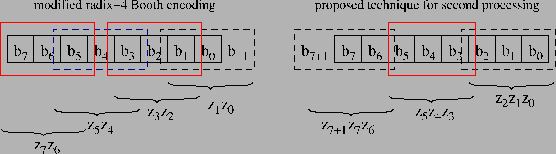
It is important to note that the index  used in the table above has to be incremented in steps of 3 in order to cover the encoding scheme correctly. A graphical overview of this encoding in comparison with modified Booth encoding is shown on Figure .
 |
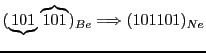
By looking at Table we can spot a disadvantage in the new encoding methodology, since it does not overlappingly scan through the binary vectors. In this case there might be missed processed adjacent ones by the algorithm. As an example we can consider the following case below:
 |
(2) |
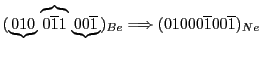
As noted before, this fact is due to the non-scanning nature of the new technique, however for a large part of the cases it will lead to a reduction of non-zero partial products. Let us consider as an example the case:
 |
(3) |
In addition it should be also mentioned that for cases ( and
 ) (also separated in the bottom of Table ), encoding can not be performed unless we do not know the value of the adjacent bits of the scanned pattern. This is another drawback which could be added to the list due to the static scanning nature of the technique.
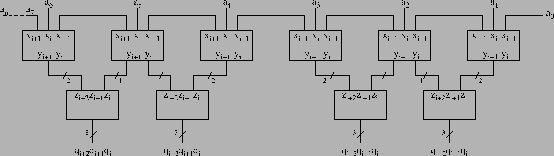
A property in favour of the non-scanning encoding is that it could be implemented using very little combinatorial logic gates. For a better overview of how the new encoding could be implemented, the block-diagram on Figure shows a possible way of implementation with a block-level schematic.
Deyan Levski 2013-06-22